.png?width=350&height=42&name=Large_DSI_Logo-white-2018%20(1).png "DSI Logo2.png")
Emerson DeltaV RTS is a powerful, enterprise-grade scheduling engine designed for complex manufacturing environments.
It is known for:
RTS is especially effective in environments where:
While RTS is powerful, that power comes with a cost—complexity.
RTS relies on:
This creates:
RTS uses:
This often leads to:
In RTS environments:
Over time, many RTS implementations reach a point where:
SchedDSI is built to deliver the same level of scheduling capability—but with a modern, flexible, and accessible architecture.
SchedDSI uses:
This makes the system:
Instead of a proprietary scripting language, SchedDSI allows:
This enables:
Example capabilities:
Schedulers and engineers can:
This reduces:
With SchedDSI:
SchedDSI focuses on:
It is designed for environments where:
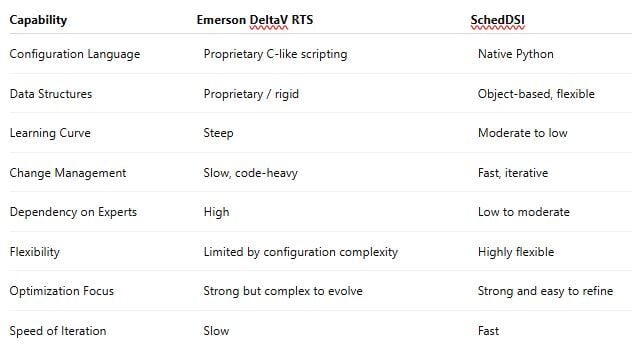
RTS may be appropriate if:

SchedDSI delivers the most value when:
Emerson DeltaV RTS is:
A powerful but highly customized scheduling engine that requires specialized expertise
SchedDSI is:
A modern scheduling platform designed for flexibility, speed, and accessibility
Both systems can produce effective schedules.
But the real question is:
How fast can your team adapt, improve, and evolve those schedules over time?
SchedDSI is built to make that process:
If your current scheduling environment feels:
SchedDSI can show you a simpler, more flexible path forward.
👉 Request a demo and see how SchedDSI can unlock your scheduling potential.

We're always happy to chat about what we do, why, and how. Get in touch with us and start the conversation. We'd love to hear from you.
